What is a company brain?
A company brain knows your entire business, and can find the exact information you need the moment you need it.
A company brain contains everything there is to know about your business. This includes your policies, product range, product manuals, customer support tickets, supplier emails, social media content, ads, YouTube content, KPIs, team roles, and everything else that makes your business tick. Including the expert knowledge that usually only lives in a few people's heads.
A brain's knowledge base is organised in a unique manner so you can find the right information in fractions of a second.
Company brains are new, and most businesses haven't heard of them yet. But with the increase in AI adoption, many companies are discovering that they need a centralized service that enables their AI of choice to interface with their company's knowledge in a fast and secure manner.
ChatGPT knows the internet. A company brain enables it to know your business.
What is a company brain?
A company brain is your business's knowledge in one place, organised so AI tools can find the right piece of it fast.
Think of the world's most efficient library. You ask the librarian any question and they find the exact page you need out of thousands in a second. A brain turns your company data into that library. Every policy, manual, old ticket, and supplier email, filed and labelled.
Your AI tools are the people who ask at the desk, then write up the answer.
A company brain does three things:
- It holds your business's knowledge: A live system that can be updated as new information comes in
- It finds the right piece: It finds the exact information you need, and it never makes things up
- It shows its source: Every piece comes back with where it came from, so you can actually check it
A company brain isn't an AI bot. ChatGPT, Claude, and the AI agents your business uses are the ones that talk and write. The brain is what they ask, so their answers come referenced from your records, instead of a guess.
How does a company brain work?
A company brain works in five steps: it reads your business's records, files every piece with a label, takes questions from your team's tools, hands back the right pieces with the source, and learns from your team's feedback.
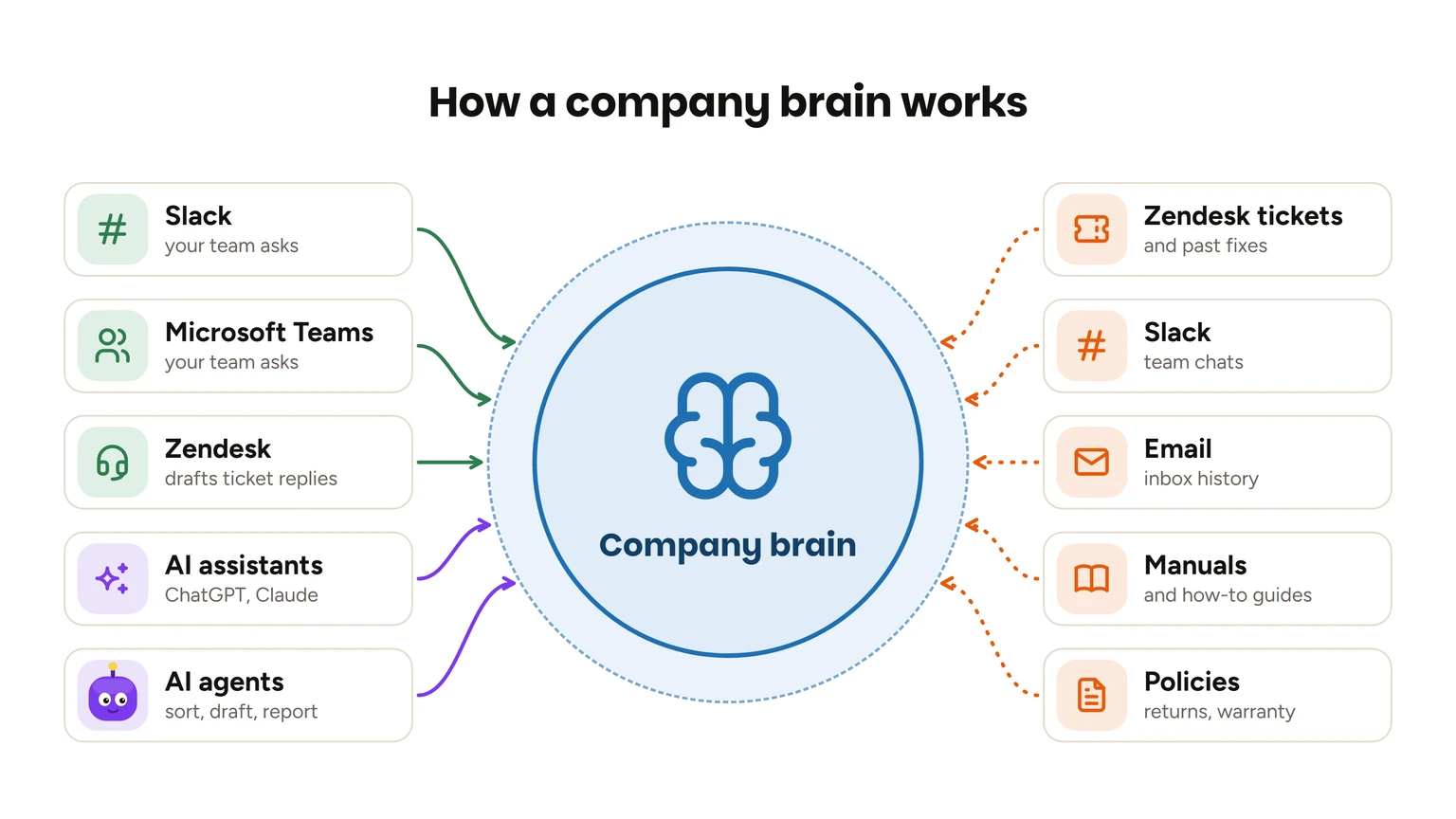
- It reads what you give it: Manuals, policies, past tickets, supplier emails, spreadsheets, and team chats. Every night, it re-reads anything that changed, so a new returns policy is in the brain by morning.
- It files every piece with a label: Each piece gets what it's about, where it came from, who owns it, and when it was last checked. That's how the brain knows the returns policy is Sam's, and how it can flag a guide nobody has checked in a year, or two documents that disagree.
- Your tools ask it a question: Your team asks in Slack, Microsoft Teams, the helpdesk, email, or a dashboard, and the AI there asks the brain. Other AI agents can ask it too.
- It hands back the right pieces, and shows where from: The AI writes the answer from those pieces. If nothing in your records answers it, the brain says so and names who to ask.
- It learns from your team's feedback: When someone says an answer's wrong, out of date, or missing, the fix goes into the brain straight away, so the next person gets it right.
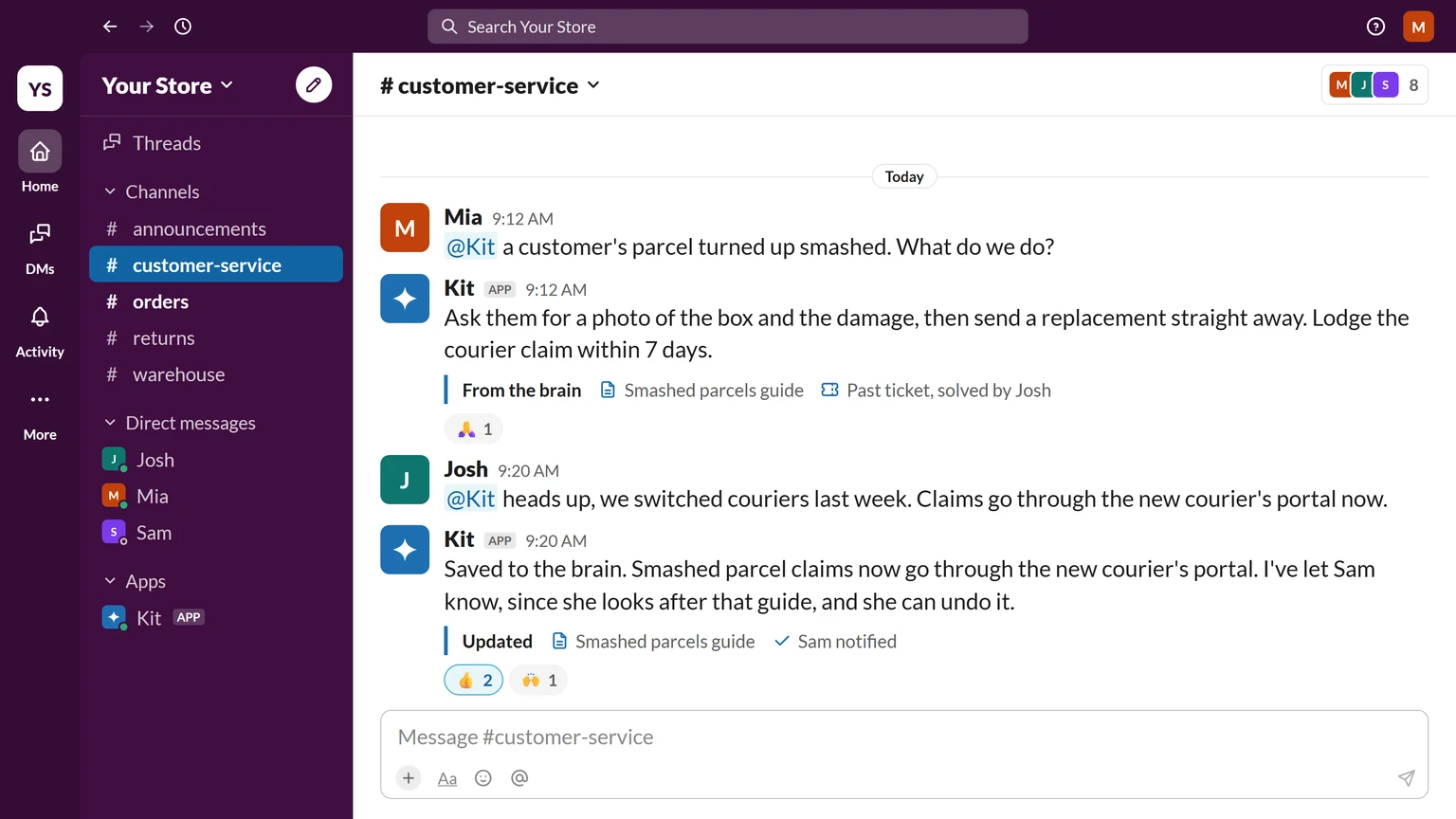
Step 5 is why a company brain gets better the more your team uses it. Fixing a wrong answer takes one message: when someone tells the AI in Slack that the courier's changed, it saves the fix to the brain for everyone and tells the person who looks after that guide, who can check it or undo it.
When the brain says "ask Sam" and Sam answers, that answer can go into the brain too, so nobody has to ask Sam again. Every correction and every filled gap makes the next answer better, without anyone sitting down to update a manual.
What can a company brain do for your team?
A company brain gets your team the right answer in seconds, from your own records, so nobody has to stop what they're doing to hunt for an answer or wait for the one person who knows.
You'll likely already understand how that hunting adds up. Australian knowledge workers spend 23.5% of their working week, roughly 10 hours, searching for information, according to an Atlassian survey of 12,000 workers.
Company brains can slash wasted time and boost overall efficiency in your business.
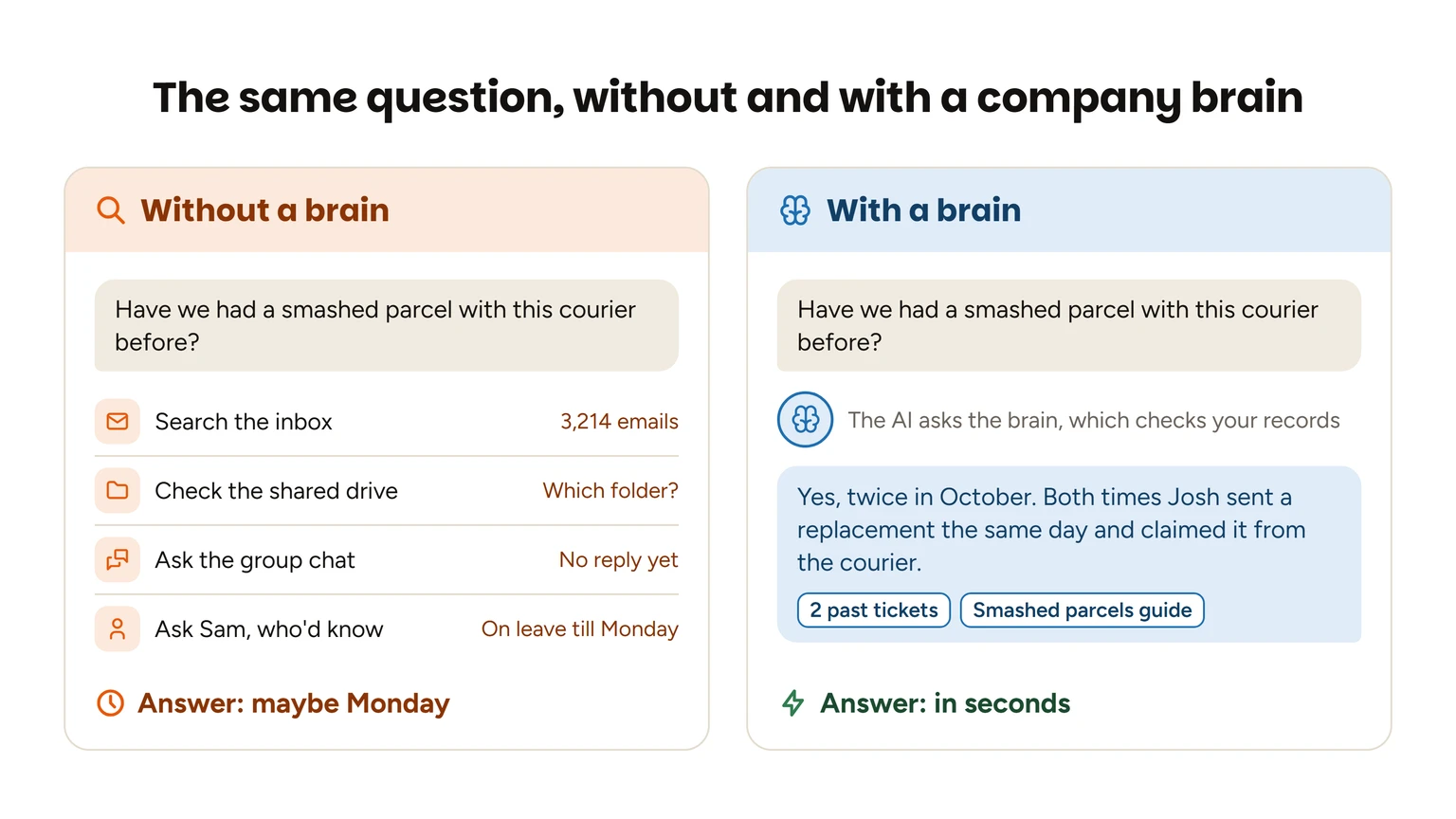
A company brain helps a team in four ways:
- The same questions are answered the same way: "What do we do with a smashed parcel?" gets the same right answer at 9am and 9pm
- New staff up to speed faster: They ask in Slack or Teams instead of tapping someone on the shoulder every ten minutes
- No single point of failure: When the person who knows is on leave, or moves on, what they knew stays in the brain
- Better helpdesk replies: The brain hands whoever's answering a ticket the policy and what fixed it last time
In a team chat, it works like this: a staff member asks an AI agent, the agent pulls the right pieces from the brain and answers with the sources, and a fix takes one message. It can just as easily be done via email or whatever other chat solution your team uses.
What goes into a company brain?
Anything your business knows can go into a company brain, and you choose what goes in.
Most businesses start with what staff ask about most: policies, product manuals, how-to guides, and past customer tickets with how each one was solved. Supplier emails and price lists, spreadsheets, meeting notes, and team chat channels can follow. If it's written down somewhere, a company brain can read it.
Sensitive information gets guardrails. Payroll, staff records, or anything else private can be locked to the managers who should see it, or left out completely. Old tickets also hold customers' names, emails, and addresses. That's personal information, and the Privacy Act 1988 covers how businesses turning over more than $3 million a year (and some smaller ones) handle it, so the brain should only show it to staff who need it.
A company brain should also be a separate service from any chatbot on your website. The website chat only needs what's public: products, prices, policies, and manuals. The brain holds the private stuff specific to the running of your business.
Keeping the two apart means you can sleep at night knowing someone on your website isn't asking the chatbot about payroll.
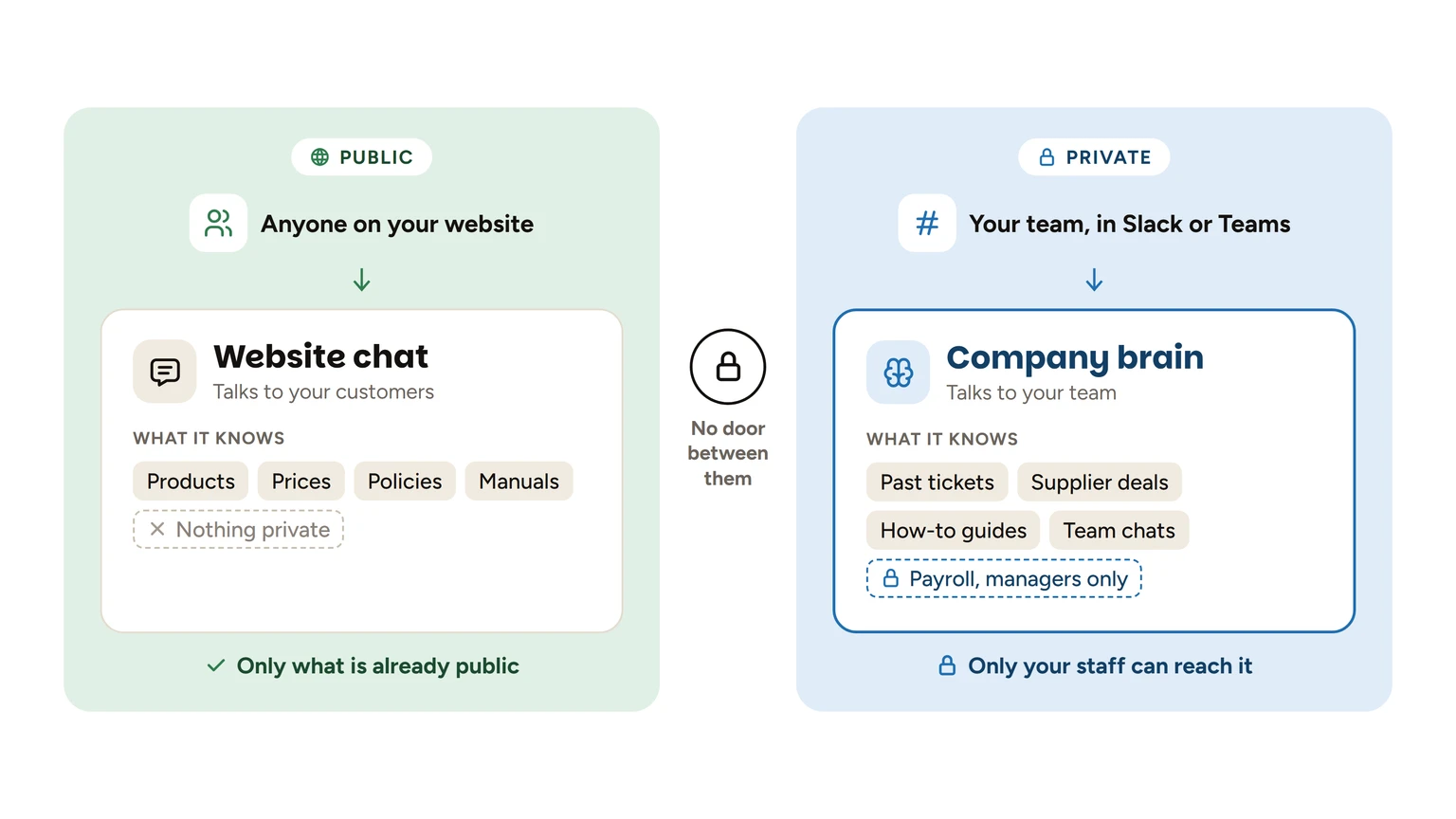
That's how Matey builds them. The chat on your website, the kind we make in our custom chatbot development, and the brain for your team are two separate services with no door between them.
Where does a company brain live?
A company brain sits in one place, and your team reaches it from the tools they already use: Slack, Microsoft Teams, the helpdesk, email, or a dashboard.
There's no new app to learn. Anything that knows how to ask the brain a question can use it. Someone asks in Slack, the helpdesk drafts a reply beside a ticket, and both get their facts from the same brain.
Other AI tools can ask it too. AI agents that draft helpdesk replies, sort the inbox, or write product descriptions do better work when they check the company brain first, because they're working from your records instead of guessing.
Who builds company brains?
Company brains are built by teams that specialise in custom AI agents, and some larger businesses build their own. And of course, Matey builds company brains for Australian businesses.
Brains can start as small or as big as you want them. And once the team trusts it, more goes in.
- Your records and rules: built around how your business runs, not a template
- Your tools: it plugs into the tools your team already uses, so nobody learns a new app
- Your guardrails: sensitive information stays locked to the people who should see it
- Kept current: it re-reads what changed every night, learns from your team's fixes, and we look after it
If your team keeps asking the same questions, or one person holds all the answers, a company brain is worth thinking about.
How much does a company brain cost?
A basic custom company brain usually costs $25,000 to $50,000 to build, then $700 to $2,000 a month to run and look after. Bigger ones that pull from many sources cost $50,000 to $120,000, and enterprise builds can pass $250,000.
Those are the published prices from Team400, an Australian AI consultancy, for what the industry calls a RAG system, which is a dated approach to company brains. At the top end, its enterprise builds also cost $5,000 to $20,000 a month to run and maintain.
At Matey, we think this pricing is a bit ridiculous. Our brain setups are much cheaper than the competition, and have proven to preform significantly better when compared to basic RAG systems generally on offer.
For the initial build, this is what you're actually paying for:
- Gathering and tidying your records: pulling in manuals, policies, tickets, and chats, and cleaning them up
- Filing every piece: so the brain finds the right one and shows where it came from
- Connecting your tools: Slack, Teams, the helpdesk, or whatever your team already uses
- Setting the guardrails: who can see what, like payroll for managers only
- Testing: asking it the questions your team really asks, and checking it finds the right answer
The monthly cost is the upkeep:
- Running it: hosting, and the AI that reads each question
- Keeping it current: re-reading what changed every night, and fixing connections when your tools update
- Learning from your team: saving their corrections, so it keeps getting better
The real price depends on how much goes in, how many tools it connects to, and how tidy your records are. A brain that starts with one team and a few sources costs less than one that reads everything on day one. The best way to get a real number is to ask whoever's building it for a quote on your business, covering both the build and the monthly upkeep.
Matey quotes every company brain on what your business actually needs. Tell us what your team asks most and where the answers live, and we'll give you both numbers.
FAQs
What is a company brain in AI?
A company brain in AI is a business's own knowledge, like its policies, manuals, past tickets, and team chats, kept in one place and organised so AI tools can find the right piece. When an AI asks it a question, it hands back the pieces that answer it with where they came from, or says the answer isn't there.
What is a company brain for AI agents?
A company brain for AI agents is the shared source of facts a business's AI tools check before they act. An AI agent drafting a helpdesk reply, for example, asks the company brain for the policy and what fixed the problem last time, then writes from those pieces instead of guessing.
What is a company brain for teams?
A company brain for teams lets anyone get answers from the business's own records inside the chat tools they already use, like Slack or Microsoft Teams. The AI in the chat asks the brain, so nobody waits on the one person who knows how something's done or what fixed a problem last time.
Is a company brain the same as ChatGPT?
No. ChatGPT is an AI that writes answers, and it only knows your business when someone pastes it in. A company brain isn't another AI bot: it's your business's knowledge, organised so ChatGPT, Claude, or your own AI agents can find the right piece, with its source.
Is a company brain safe for private business information?
A company brain is as safe as the rules on who can see what. Sensitive information like payroll can be locked to managers or left out completely, and a brain for staff should be a separate service from any chatbot on your website.
Who builds company brains in Australia?
Company brains are built by teams that specialise in custom AI agents, and some larger businesses build their own. Matey builds company brains for Australian businesses, starting with one team and the questions they ask most.