Ecommerce Chatbot Statistics 2027: 4,842 Stores Checked
Ecommerce chatbot statistics for 2027 from 4,842 online stores in 5 countries: 75.1% have no chat, 7.6% have AI answering.
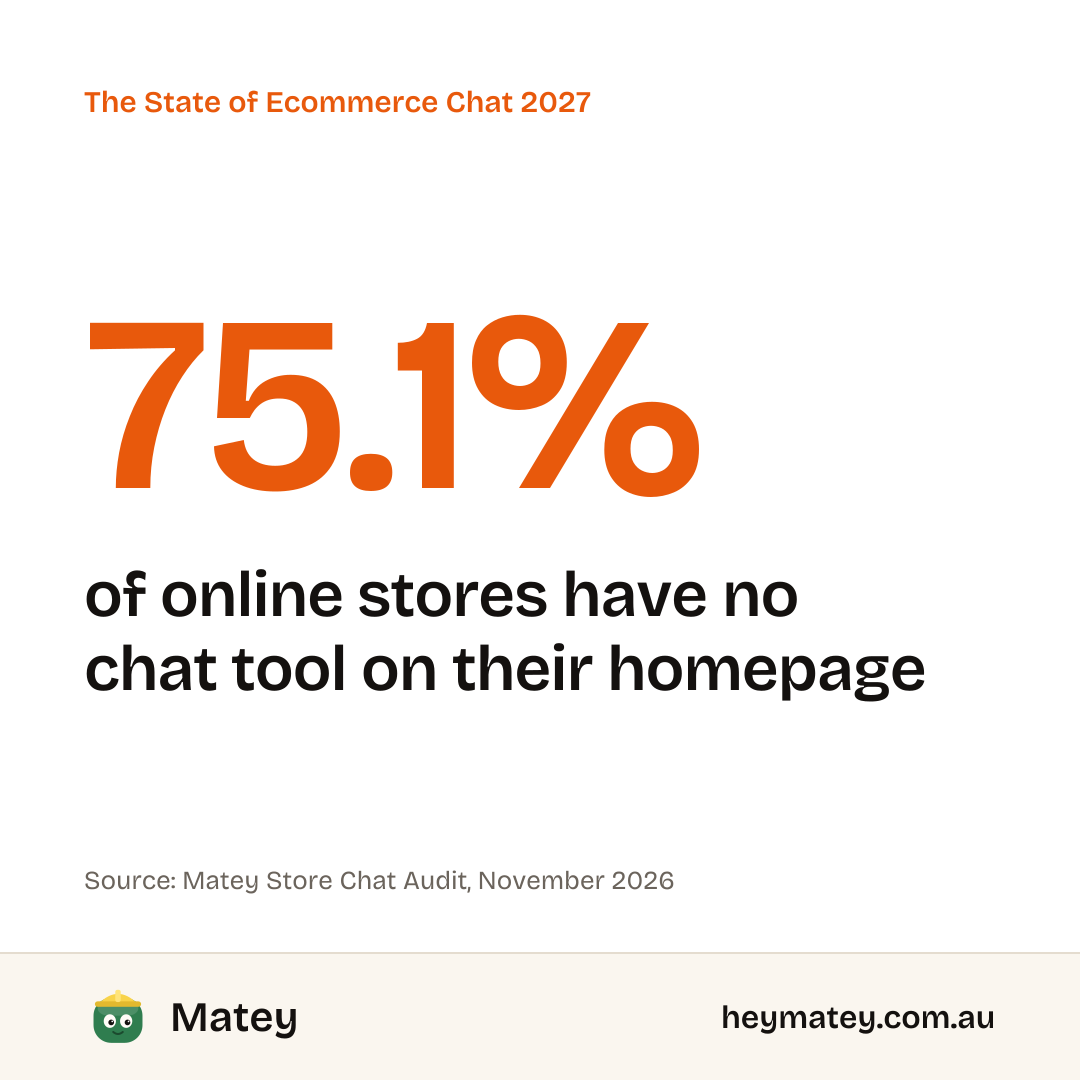
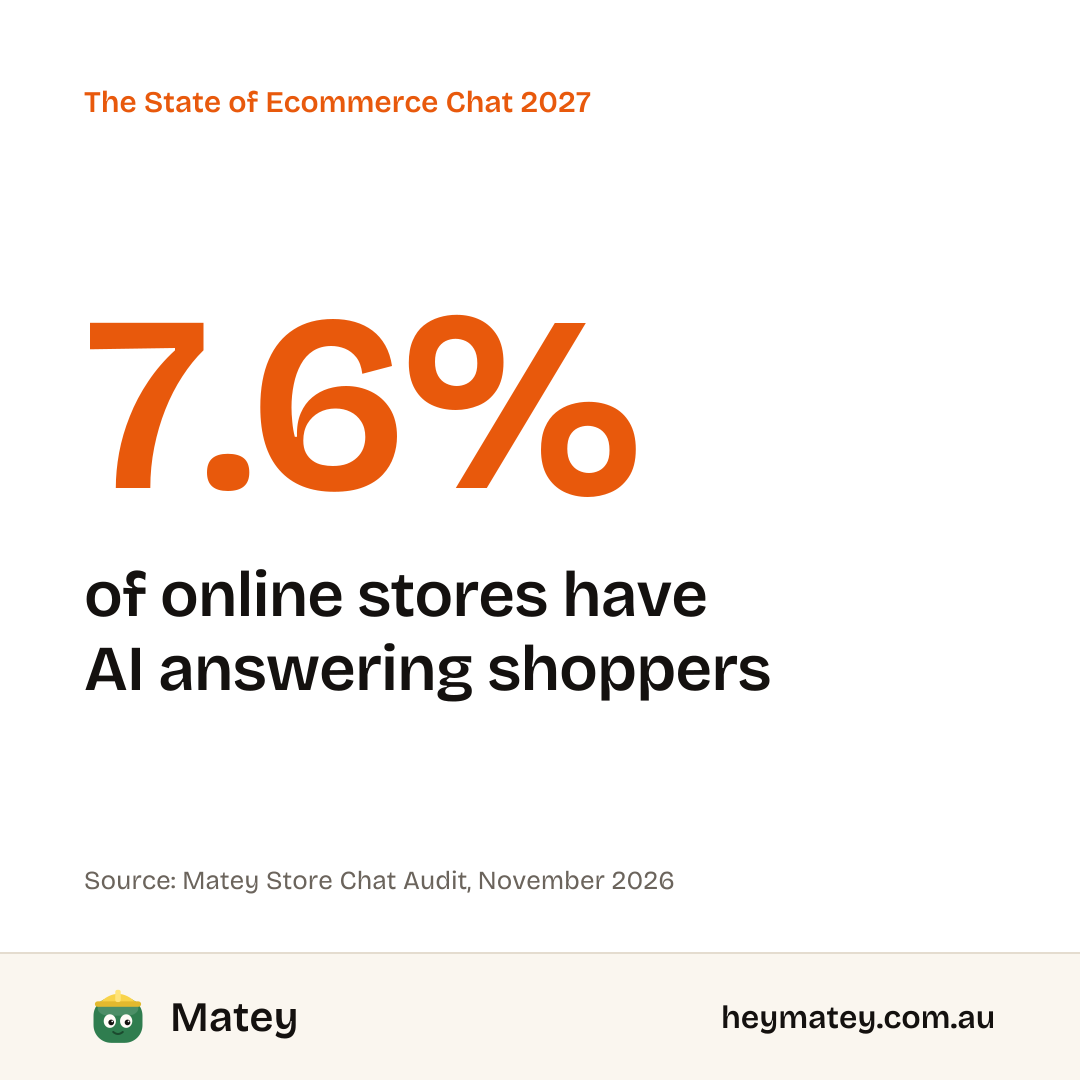
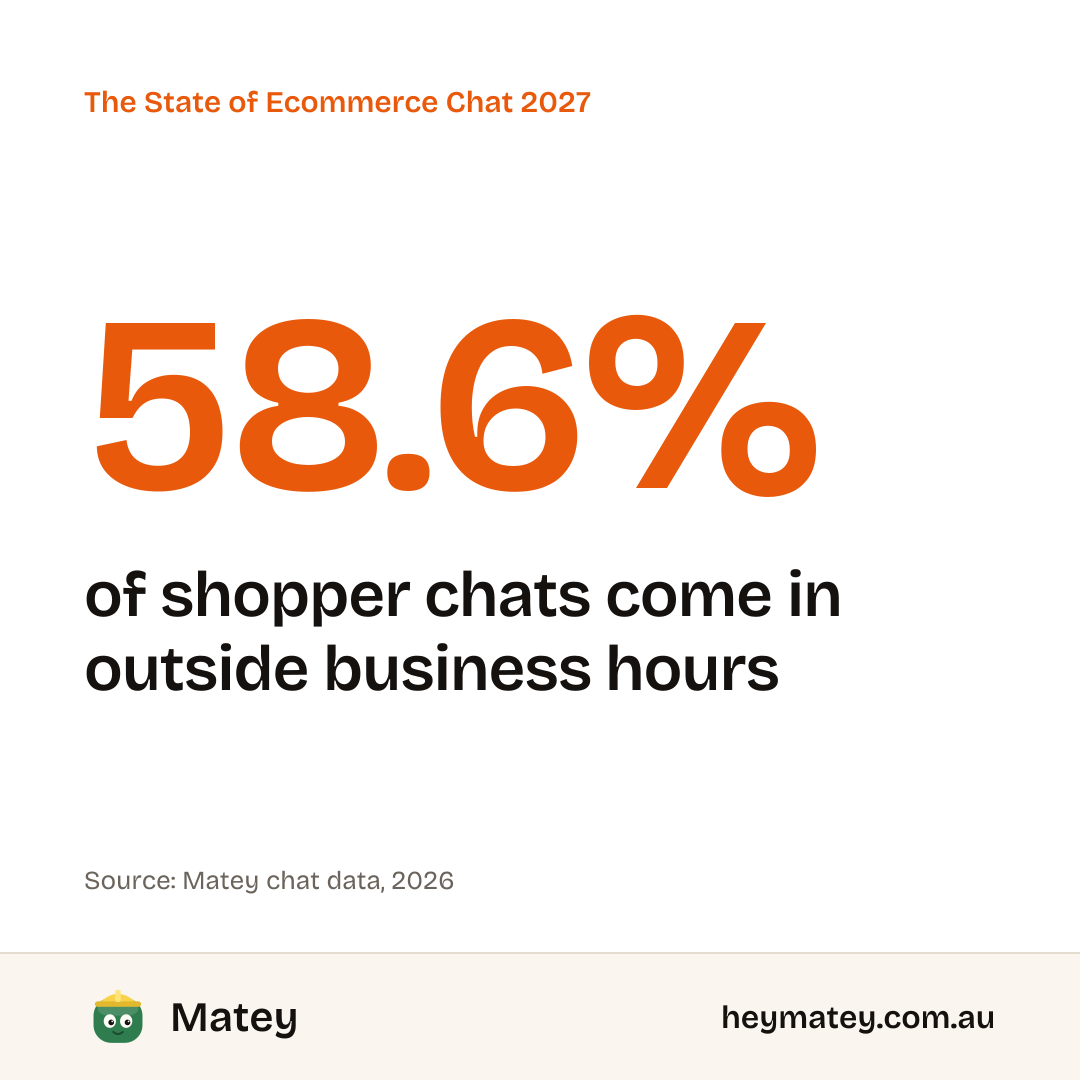
Nearly three in four online stores have no chat on their homepage, and only 7.6% have AI answering shoppers. Yet 58.6% of shopper chats on stores using Matey come in outside business hours, when nobody is there to answer live chat.
We checked the homepages of 4,842 online stores in the US, the UK, Canada, Australia, and New Zealand in November 2026. Below are our numbers from the Matey Store Chat Audit first, then the latest from Adobe, Amazon, Salesforce, Shopify, Gartner, and others, each with its source and date.
Matey designs and builds bespoke AI agents and tools for ecommerce stores, retailers, tradies, and service businesses.
Key ecommerce chatbot statistics for 2027
- 75.1% of online stores have no chat tool on their homepage, and only 7.6% have AI answering shoppers (Matey Store Chat Audit, November 2026)
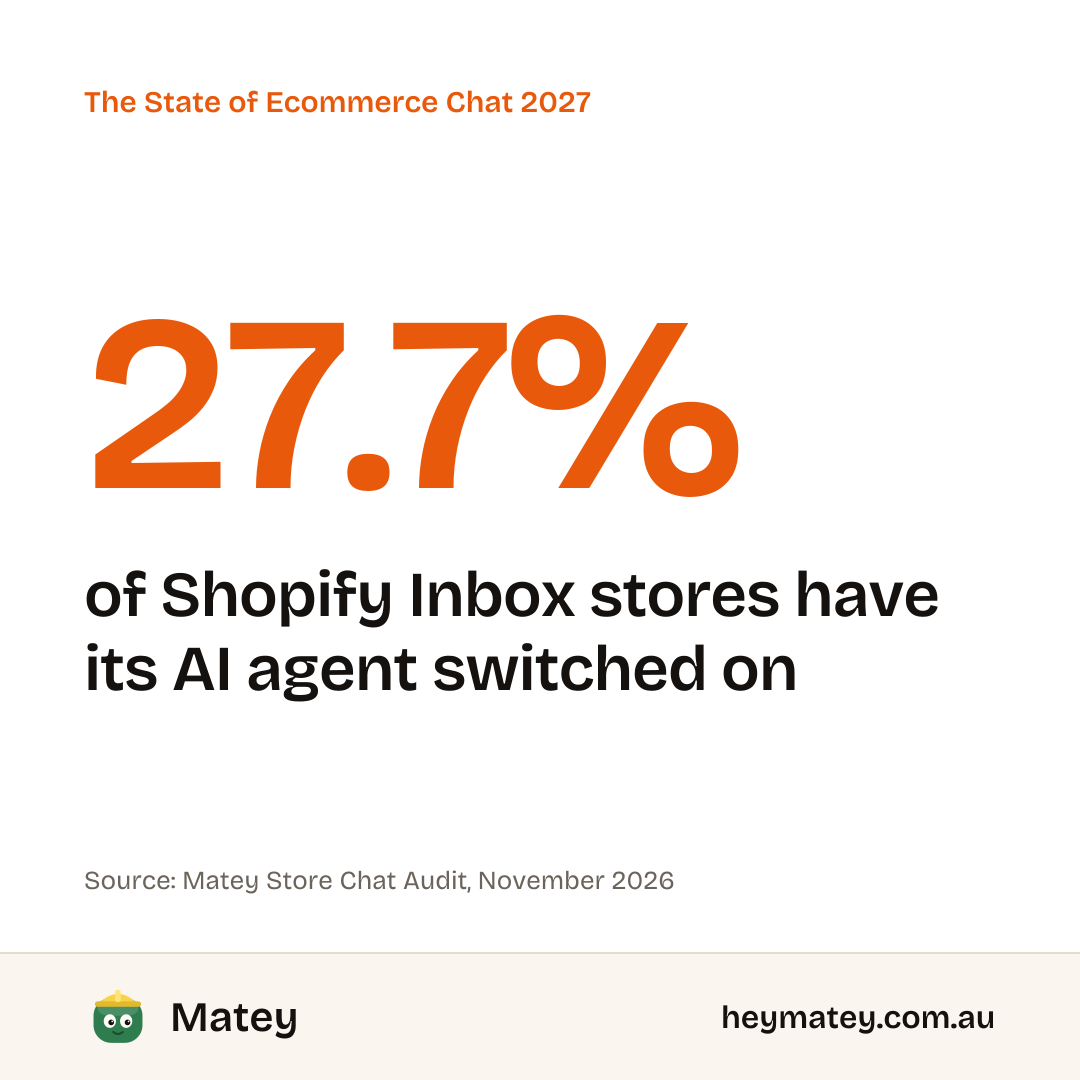
- 27.7% of Shopify Inbox stores have its AI agent switched on, and 40% of Gorgias stores run its AI Agent (Matey Store Chat Audit, November 2026)
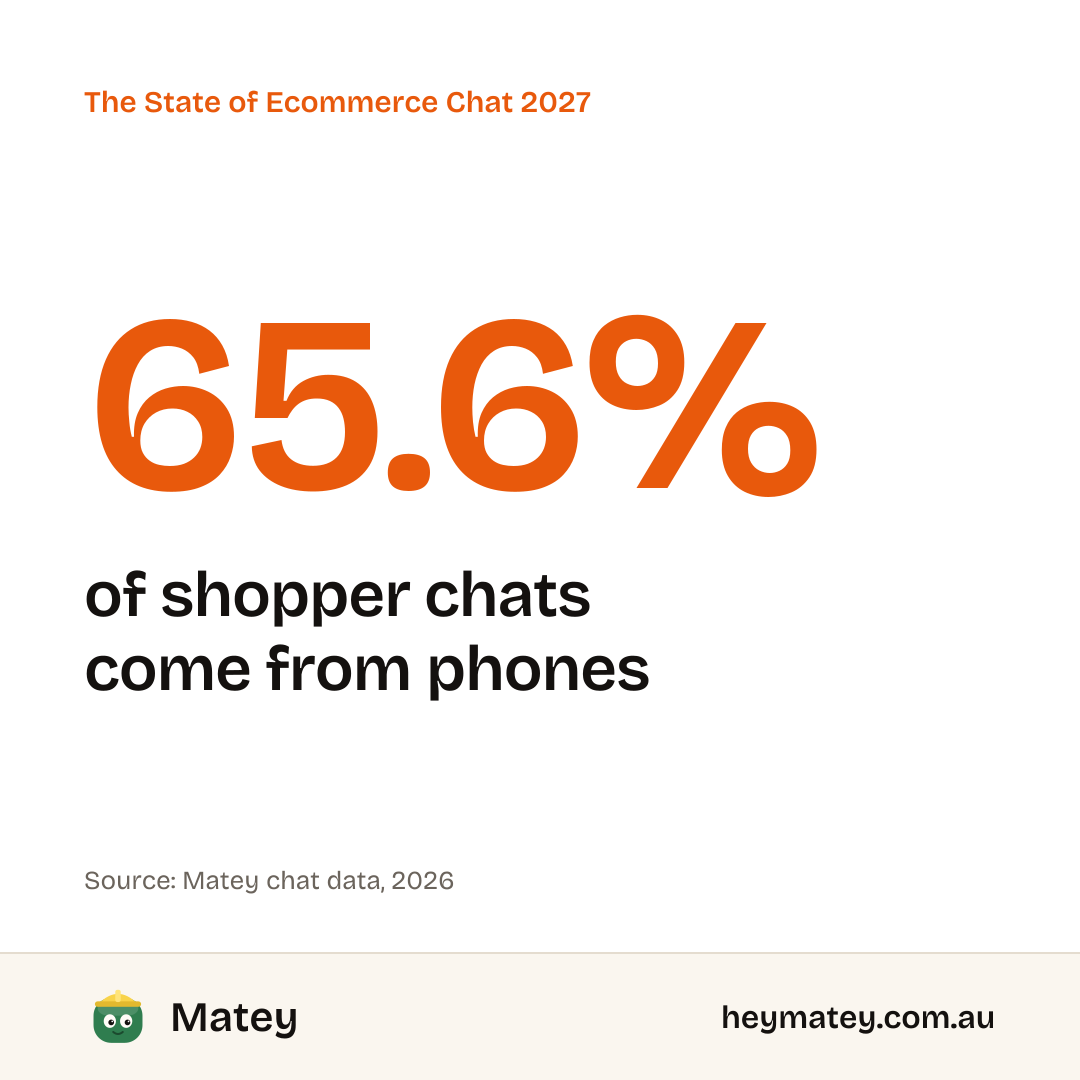
- 58.6% of shopper chats come in after hours, and 65.6% come from phones (Matey chat data, 2026)
- Shopify Inbox is the most used chat tool, on 13.2% of online stores, ahead of Gorgias on 2.6% (Matey Store Chat Audit, November 2026)
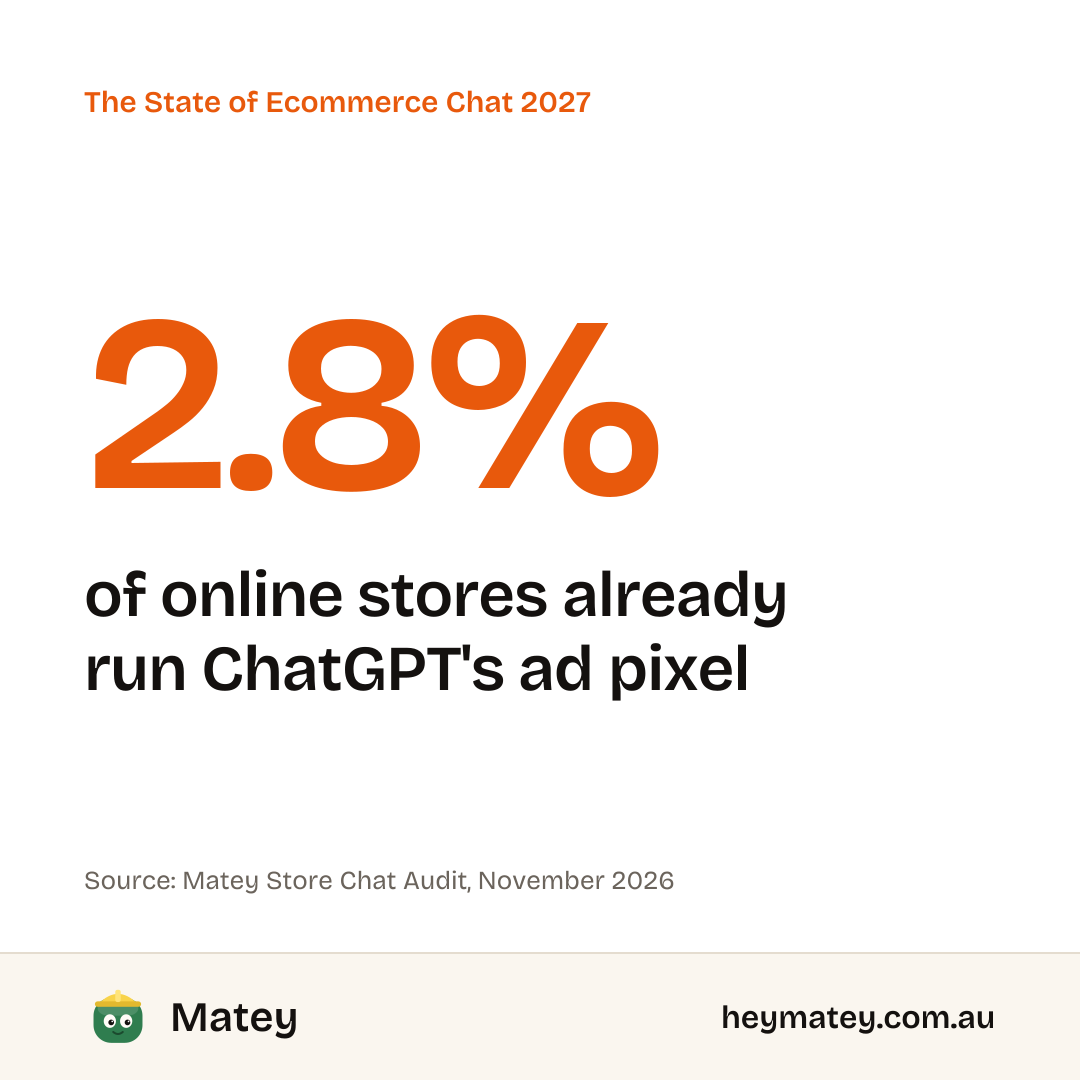
- 2.8% of online stores already run ChatGPT's ad pixel (Matey Store Chat Audit, November 2026)
- Shoppers who arrive from AI chatbots spend 83% more per visit and convert 90% better (Adobe, September 2026)
- Amazon's Rufus chatbot helped deliver nearly $12 billion in extra sales in 2025 (Amazon)
- AI and agents influenced 20% of online orders in Cyber Week 2025 (Salesforce)
- Only 27% of customers would try a chatbot again after a bad experience (Gartner, 2026)
Ecommerce chatbot adoption statistics
These numbers come from the Matey Store Chat Audit. In November 2026 we loaded the homepages of 4,900 online stores in the US, the UK, Canada, Australia, and New Zealand in a browser and recorded every chat tool that loaded. 4,842 loaded properly.
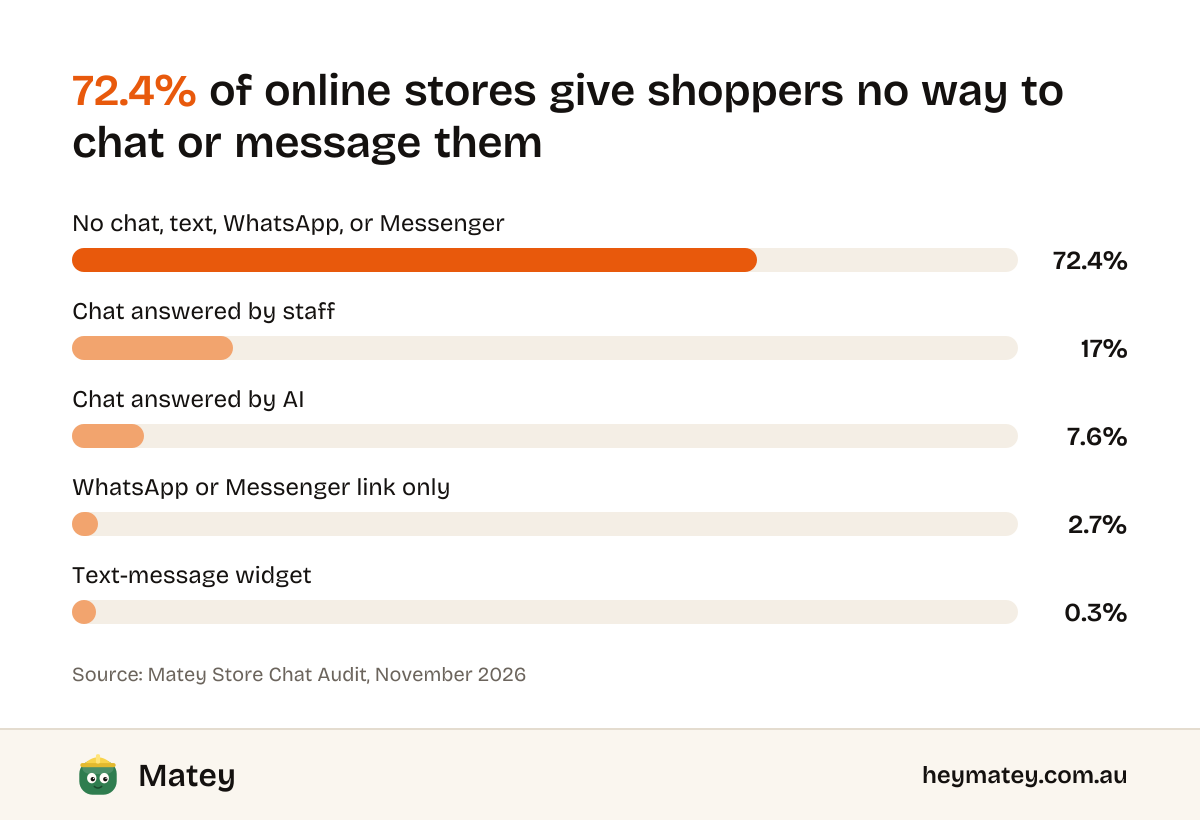
- No chat, text, WhatsApp, or Messenger72.4%
- Chat answered by staff17%
- Chat answered by AI7.6%
- WhatsApp or Messenger link only2.7%
- Text-message widget0.3%
Source: Matey Store Chat Audit, November 2026
75.1% of online stores have no chat tool on their homepage
- 3,636 of 4,842 online stores had no live chat, chatbot, or text-message widget on their homepage (Matey Store Chat Audit, November 2026)
- 72.4% offered no chat, text-message, WhatsApp, or Messenger option at all
- 24.9% ran at least one chat tool, and 0.5% ran two or more at once
- 3.4% offered WhatsApp chat, through a button or a link
- 25 stores (0.5%) still carried the code for Facebook's Messenger chat plugin, which Meta switched off on 9 May 2024, so their chat button no longer shows
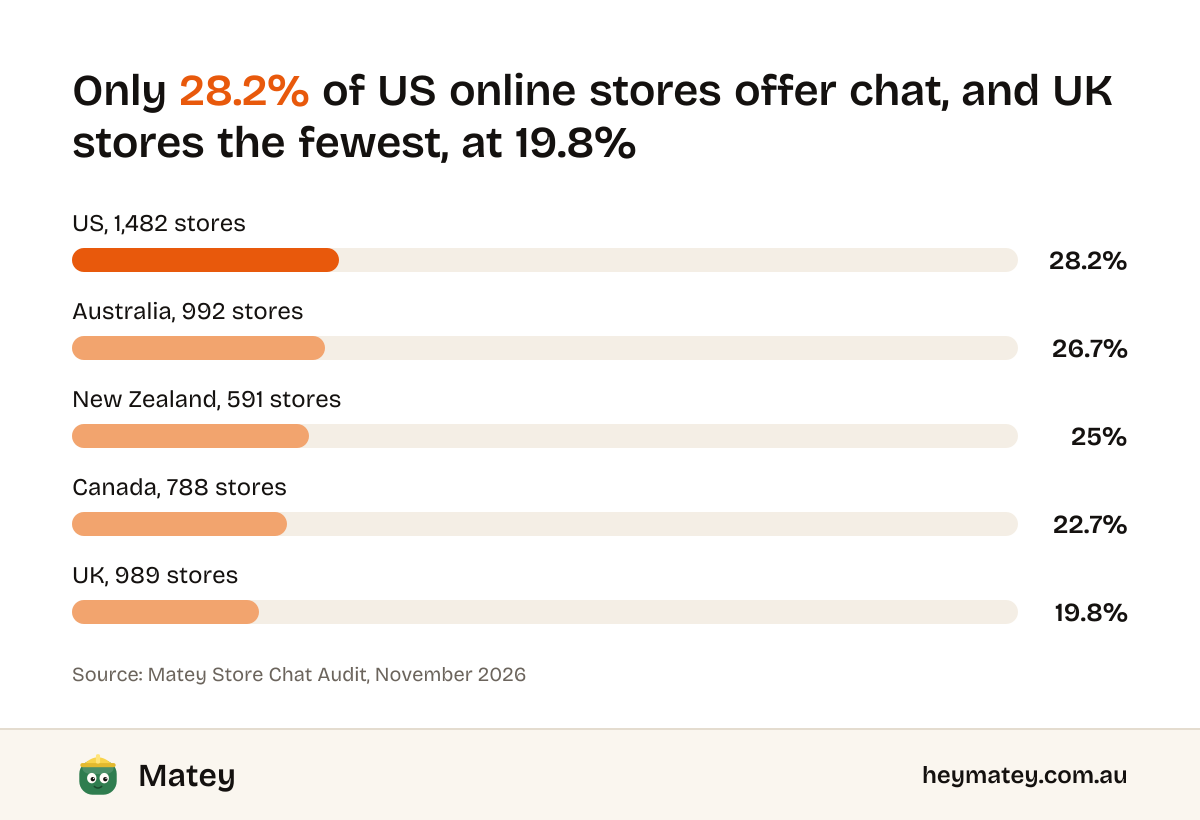
- US, 1,482 stores28.2%
- Australia, 992 stores26.7%
- New Zealand, 591 stores25%
- Canada, 788 stores22.7%
- UK, 989 stores19.8%
Source: Matey Store Chat Audit, November 2026
Only 28.2% of US online stores offer chat, and UK stores the fewest, at 19.8%
- Online stores with a chat tool on their homepage: 28.2% in the US, 26.7% in Australia, 25% in New Zealand, 22.7% in Canada, and 19.8% in the UK (Matey Store Chat Audit, November 2026)
- US stores were the most likely of the five countries to have one, and UK stores the least likely
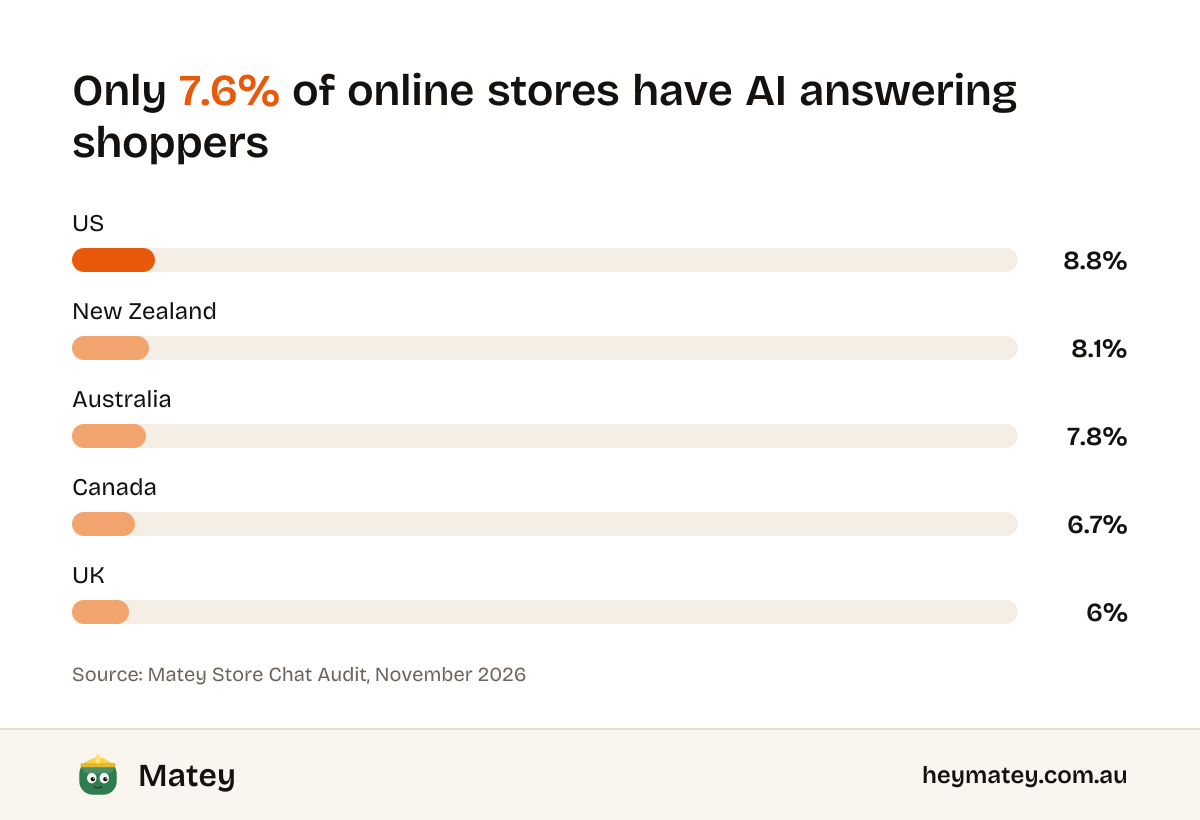
Only 7.6% of online stores have AI answering shoppers
- 7.6% of online stores have AI answering shoppers in their chat, which leaves 92.4% with none (Matey Store Chat Audit, November 2026)
- By country: 8.8% in the US, 8.1% in New Zealand, 7.8% in Australia, 6.7% in Canada, and 6% in the UK
- Another 17% of stores have a chat that only staff answer
- 0.5% of stores run a dedicated AI chatbot. The ones we found most often were Rep AI (8 stores), Zipchat (8 stores), Chatbase (4 stores), and Botpress (1 store)
- Our AI agent statistics show how many of the same stores already have a shopping endpoint for outside AI agents (77.7%), and how few block them (0.3%)
- US8.8%
- New Zealand8.1%
- Australia7.8%
- Canada6.7%
- UK6%
Source: Matey Store Chat Audit, November 2026
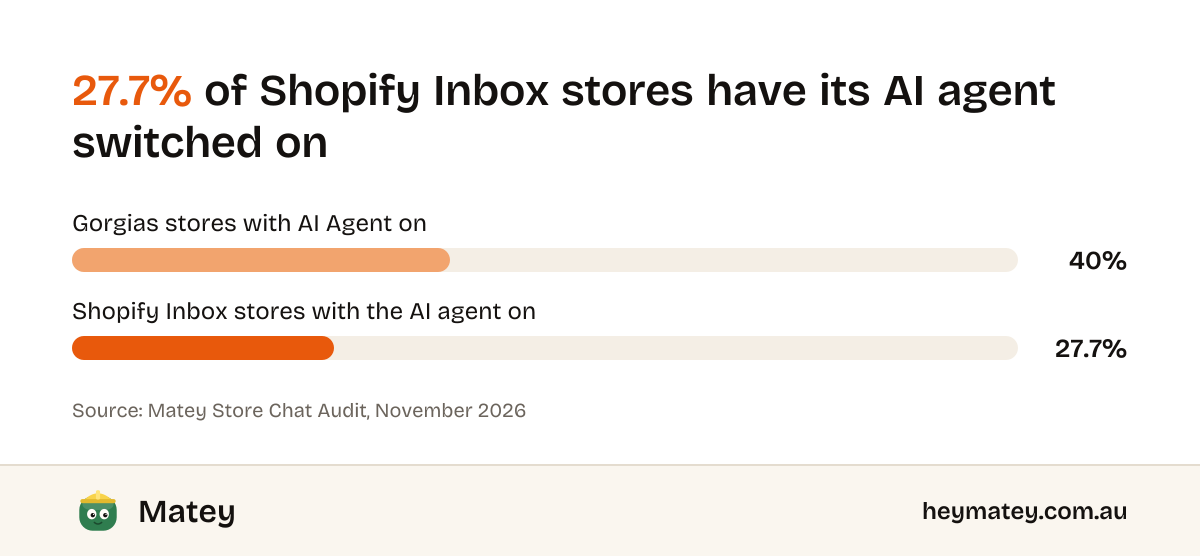
27.7% of Shopify Inbox stores have its AI agent switched on
- Shopify Inbox can answer shoppers with an AI agent. 27.7% of Shopify Inbox stores had the agent answering (172 of 622), and staff answered on the rest (Matey Store Chat Audit, November 2026)
- 40% of Gorgias stores had its AI Agent switched on (50 of 125)
- Gorgias stores with AI Agent on40%
- Shopify Inbox stores with the AI agent on27.7%
Source: Matey Store Chat Audit, November 2026
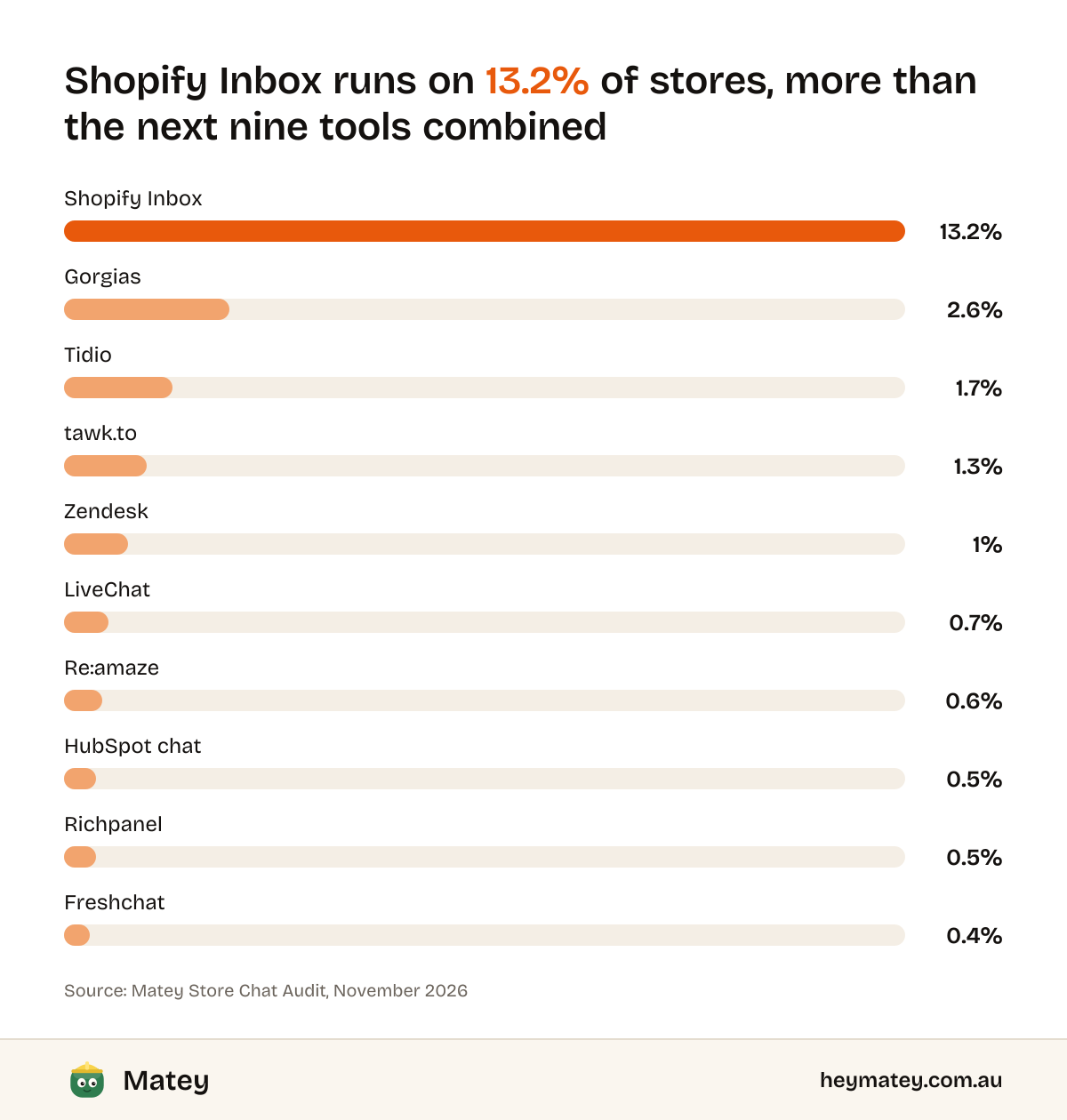
Shopify Inbox runs on 13.2% of stores, more than the next nine tools combined
- Shopify Inbox ran on 638 of 4,842 stores, 52.9% of stores with any chat tool (Matey Store Chat Audit, November 2026)
- Gorgias came second on 2.6%, then Tidio on 1.7%
- Then came tawk.to (1.3%), Zendesk (1%), LiveChat (0.7%), and Re:amaze (0.6%)
- Our guide to Shopify Inbox alternatives compares the main options with prices
- Shopify Inbox13.2%
- Gorgias2.6%
- Tidio1.7%
- tawk.to1.3%
- Zendesk1%
- LiveChat0.7%
- Re:amaze0.6%
- HubSpot chat0.5%
- Richpanel0.5%
- Freshchat0.4%
Source: Matey Store Chat Audit, November 2026
After-hours chat statistics
58.6% of shopper chats come in outside business hours
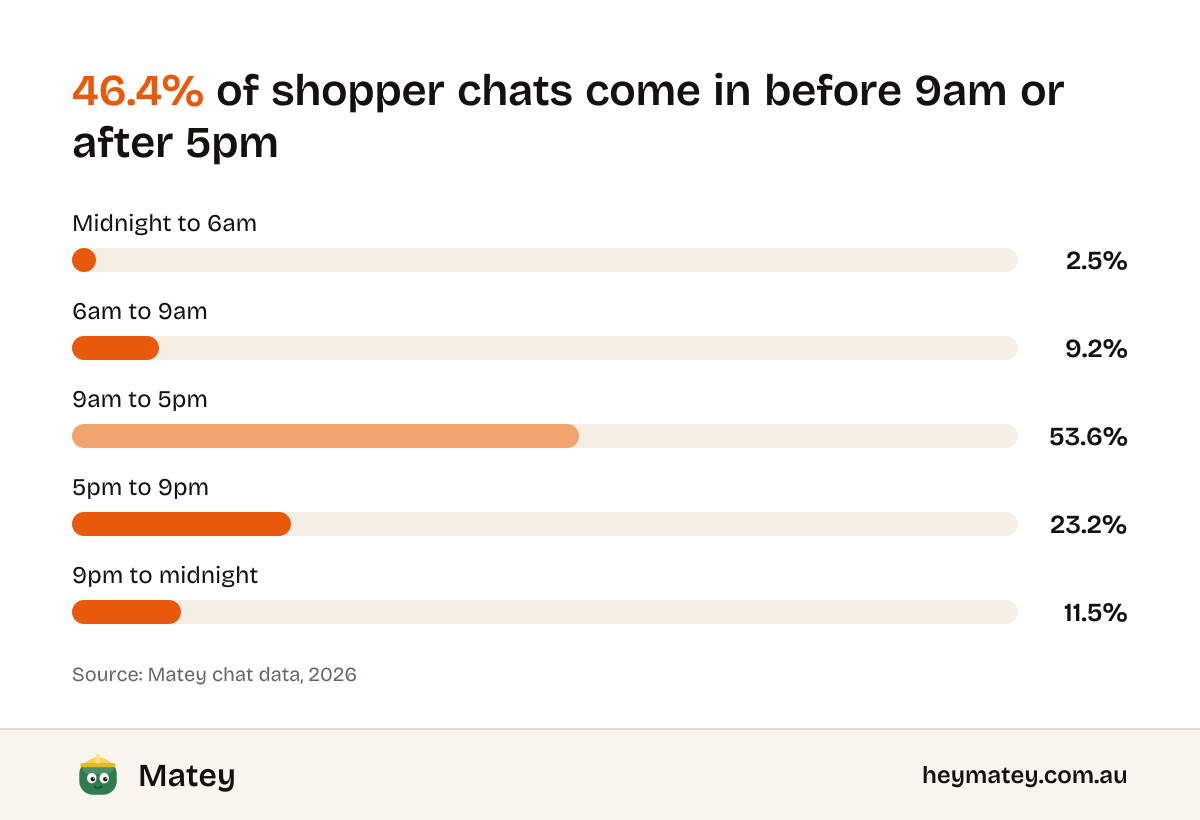
- 58.6% of shopper chats with Matey's AI shop assistants came in before 9am, after 5pm, or on weekends, in the store's own time (Matey chat data, 2026)
- 32.2% came between 6pm and 6am, and 22.4% on weekends
- The busiest stretch outside business hours was 5pm to 9pm, with 23.2% of all chats
- 65.6% of the chats came from phones
- Midnight to 6am2.5%
- 6am to 9am9.2%
- 9am to 5pm53.6%
- 5pm to 9pm23.2%
- 9pm to midnight11.5%
Source: Matey chat data, 2026
What shoppers ask AI shop assistants
24.4% of shopper chats ask about size and fit
- 24.4% of shopper chats asked about size and fit, 14.2% about price, sales, and codes, and 13% about returns and exchanges (Matey chat data, 2026)
- 62.6% of chats ended with the assistant showing products
- Shoppers asked 2.11 questions per chat on average
Chat by platform and store size
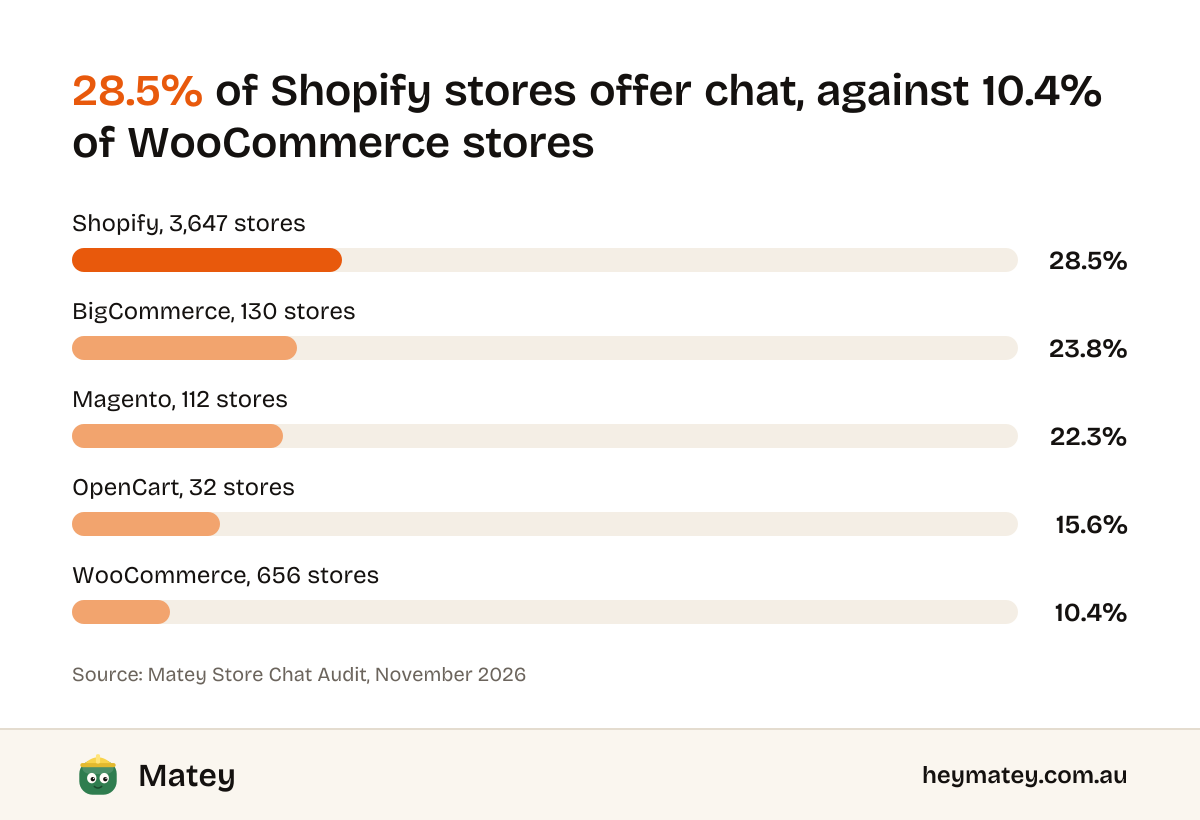
28.5% of Shopify stores have a chat tool, against 10.4% of WooCommerce stores
- Online stores with a chat tool, by platform: Shopify 28.5%, BigCommerce 23.8%, Magento 22.3%, OpenCart 15.6%, and WooCommerce 10.4% (Matey Store Chat Audit, November 2026)
- Shopify powered 75.3% of the stores we checked, WooCommerce 13.5%, custom-built stores 3.2%, and BigCommerce 2.7%
- Shopify, 3,647 stores28.5%
- BigCommerce, 130 stores23.8%
- Magento, 112 stores22.3%
- OpenCart, 32 stores15.6%
- WooCommerce, 656 stores10.4%
Source: Matey Store Chat Audit, November 2026
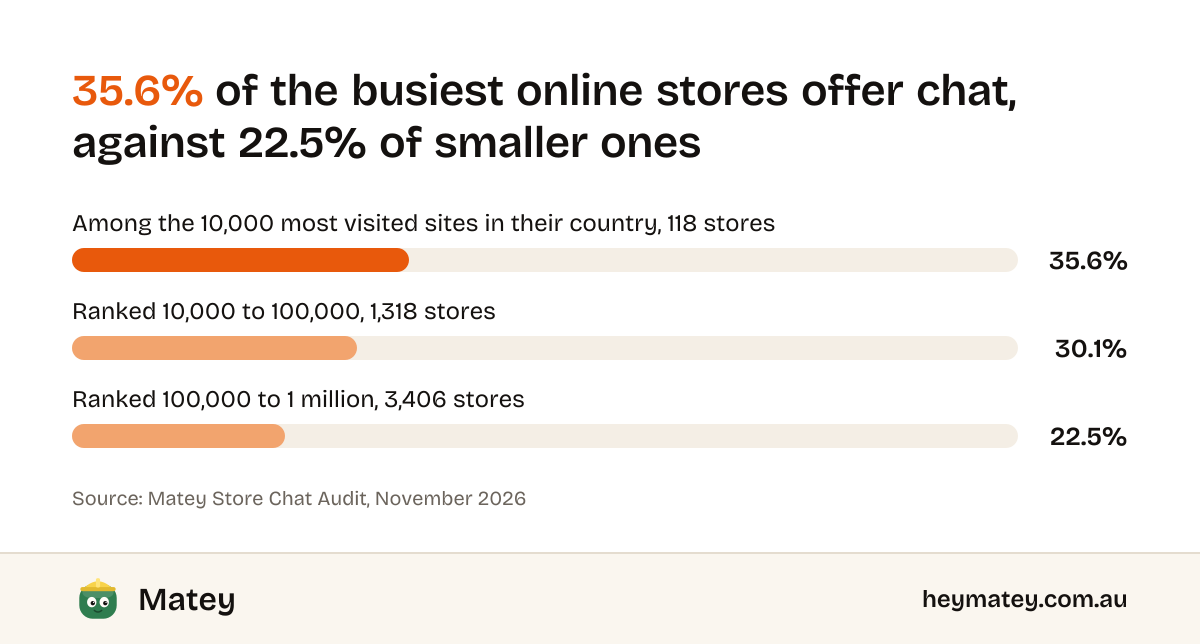
35.6% of the busiest online stores have a chat tool, against 22.5% of smaller ones
- Among stores in the 10,000 most visited websites in their country, 35.6% had a chat tool, against 30.1% of stores ranked 10,000 to 100,000 and 22.5% of stores ranked 100,000 to 1 million (Matey Store Chat Audit, November 2026)
- 13.6% of the busiest stores had AI answering shoppers, against 6.9% of smaller ones
- Among the 10,000 most visited sites in their country, 118 stores35.6%
- Ranked 10,000 to 100,000, 1,318 stores30.1%
- Ranked 100,000 to 1 million, 3,406 stores22.5%
Source: Matey Store Chat Audit, November 2026
2.8% of online stores already run ChatGPT's ad pixel
- 137 of 4,842 homepages loaded OpenAI's ads measurement pixel, the code that tracks sales from ads in ChatGPT (Matey Store Chat Audit, November 2026)
- By country: 4.9% in the US, 2.5% in the UK, 1.7% in Australia, 1.7% in New Zealand, and 1.5% in Canada
AI chatbot traffic statistics for online stores
Shoppers who arrive from AI chatbots spend 83% more per visit
- Shoppers who clicked through to US retail sites from an AI chatbot or AI browser generated 83% more revenue per visit than shoppers from other sources in September 2026, according to Adobe
- They converted 90% better, stayed 73% longer, viewed 25% more pages, and added to cart 53% more often (Adobe, September 2026)
- A year earlier it ran the other way: in August 2025, visits from AI tools converted 9% worse than other visits
- Adobe's numbers come from more than 1 trillion visits to US retail sites
AI traffic to US retail sites is forecast to grow 130% over the 2026 holidays
- Adobe expects traffic from AI chatbots and AI browsers to US retail sites to rise 130% year over year between 1 November and 31 December 2026, with the biggest jump on Thanksgiving (159%)
- Over the 2025 holiday season, that traffic grew 693.4% year over year, according to Adobe
- In September 2026, AI traffic to US retail sites was up 71% on a year earlier
- In Adobe's July 2026 survey of 5,000 consumers, 77% of people who have used AI to shop online said it made them more confident in their purchase, and 69% said they're less likely to return what they bought
AI platforms sent 770.7 million visits a month to websites
- AI platforms sent an average of 770.7 million referral visits a month to websites worldwide between June 2025 and May 2026, up 117.4% on the year before, according to Similarweb
- Marketplaces like Amazon and Temu got the most, 46.8 million AI referral visits a month, triple the year before
- Beauty was the fastest-growing shopping category for AI referrals (up 312.5%), ahead of fashion (up 278.2%) and consumer electronics (up 215.4%)
ChatGPT has 1.2 billion weekly users
- OpenAI said ChatGPT reached 1.2 billion weekly users at its DevDay event on 29 September 2026
- That's up from 900 million weekly users in February 2026, and 800 million at DevDay in October 2025
- In an Exploding Topics survey of 2,338 US adults (July 2026), 65% of people who use AI said they had at least partly replaced product searches on Google with AI chatbots
AI shopping assistant statistics
Amazon's Rufus chatbot helped deliver nearly $12 billion in extra sales in 2025
- More than 300 million customers used Rufus, Amazon's AI shopping assistant, in 2025, and it helped deliver nearly $12 billion in incremental annualised sales, according to Amazon's fourth-quarter 2025 results
- Amazon says customers who use Rufus are 60% more likely to complete a purchase
- Rufus's monthly users were up 115% year over year in early 2026 and engagement was up 400%, Amazon CEO Andy Jassy said on the first-quarter 2026 earnings call
AI and agents influenced 20% of online orders in Cyber Week 2025
- AI and agents, including chatbots answering shoppers, influenced 20% of global online orders during Cyber Week 2025 (25 November to 1 December), worth $67 billion of $336.6 billion in sales, according to Salesforce
- Across the 2025 holiday season, Salesforce credits AI and agents with $262 billion of $1.29 trillion in global online sales
- Retailers that ran their own AI agents grew holiday sales 59% faster than retailers without them: 6.2% year over year against 3.9% (Salesforce, 2025)
AI orders to Shopify stores grew 3.3 times in a year
- Orders from AI tools to Shopify stores were up 3.3 times year over year in the third quarter of 2026, and traffic from AI tools was up 2.6 times, Shopify said on its Q3 2026 earnings call
- 74% of AI-attributed purchases came from outside Shopify's top 100 product categories
42% of US consumers used an AI tool to shop in the past month
- 42% of US consumers had used at least one AI tool to shop in the past month, according to NIQ data from early 2026
- 17% had used AI for product recommendations, 10% had used an AI shopping assistant, and 5% had let an AI agent place an order for them
57.5% of AI users have decided against a purchase because of a chatbot
- In an Exploding Topics survey of 2,338 US adults (July 2026), 57.5% of people who use AI said they had decided not to buy something because of information from an AI chatbot
- The same share, 57.5%, had bought a product an AI chatbot recommended, which is 41% of all consumers
- 74% of all consumers said they'd be less likely to buy if a chatbot flagged mixed or negative reviews
AI agents could orchestrate $1 trillion of US retail sales by 2030
- McKinsey estimates AI agents could orchestrate up to $1 trillion in US retail revenue by 2030, and $3 trillion to $5 trillion globally (October 2025)
- McKinsey's numbers count revenue that AI agents help orchestrate, not only orders an agent completes on its own
Chatbot customer service statistics
Only 27% of customers would try a chatbot again after a bad experience
- Only 27% of customers said they'd be willing to try a chatbot again after a negative experience, in a Gartner survey of 3,566 B2B and B2C customers (February and March 2026)
- Gartner's advice to service leaders: "prioritize reliability over reach"
49% of customers would use a company chatbot, but only 7% did
- 49% of customers said they would have used a chatbot if the company had offered one, but only 7% used a chatbot or digital assistant in their most recent service interaction (Gartner, 2026)
Customers are 3 times more likely to use ChatGPT-style tools than a company's own chatbot
- Customers are about three times more likely to use third-party AI tools like ChatGPT than a company-provided chatbot to sort out a service problem, according to Gartner (July 2026)
- Use of third-party AI tools for customer service nearly doubled in a year, while use of company chatbots hasn't changed since 2022
- 58% of customers who use AI have used it to complete a task for them, not just answer a question
87% of customers say access to a human is essential when a company uses AI
- 87% of customers say access to a human agent is essential when a company uses AI in customer service (Gartner, 2026)
Only 24% of customer service leaders have seen AI pay off
- Customer service leaders put a median 12% of their 2025 budget into AI, the most of 10 business functions, but only 24% showed a positive financial return, in a Gartner survey of 1,303 senior leaders (January to April 2026)
Download the ecommerce chatbot statistics report and data
- 72.4% of online stores give shoppers no way to chat or message them
- Only 28.2% of US online stores offer chat, and UK stores the fewest, at 19.8%
- Shopify Inbox runs on 13.2% of stores, more than the next nine tools combined
- 27.7% of Shopify Inbox stores have its AI agent switched on
- Only 7.6% of online stores have AI answering shoppers
- 28.5% of Shopify stores offer chat, against 10.4% of WooCommerce stores
- 35.6% of the busiest online stores offer chat, against 22.5% of smaller ones
- 46.4% of shopper chats come in before 9am or after 5pm
Free to use with credit and a link back (CC BY 4.0).
How we ran the Matey Store Chat Audit
- The stores: online stores from Chrome's public lists of the most visited websites in the US, the UK, Canada, Australia, and New Zealand (Chrome UX Report, September 2026), taken in a fixed random order in each country. Each site counts in one country: its country domain if it has one, otherwise the country where it ranks highest
- What counts as a store: sites built on an ecommerce platform (Shopify, WooCommerce with products on the homepage, BigCommerce, Magento, Salesforce Commerce, and others), or custom sites with a cart, add-to-cart buttons, and prices. Shopify powered 75.3% of them, WooCommerce 13.5%, custom-built stores 3.2%, and BigCommerce 2.7%
- How we checked: we loaded each homepage in a real desktop browser between 10 and 11 November 2026, moved the mouse and scrolled like a shopper, then waited for chat tools that load late. We recorded every chat tool that loaded
- AI answering: we opened each Shopify Inbox chat and read each Gorgias store's chat settings to see whether its AI agent answers shoppers, and counted dedicated AI chatbots as AI
- Real chats: totals only, from the chat databases of Australian online stores using Matey in 2026, with test chats left out
- What was left out: website builders like Squarespace and Wix, where a shop looks the same from outside as a café selling gift cards; venues and services, marketplaces, and stores that use Matey; and 58 sites that blocked automated browsers or didn't load
How to cite these ecommerce chatbot statistics
Use any number on this page, with a link back to it. For our own numbers, cite the Matey Store Chat Audit (November 2026) and link to this page. Every chart and stat card on this page can be copied, downloaded, or embedded with the link built in, and the full numbers are in the report and the spreadsheet. Every other number has its source and date beside it.
What these ecommerce chatbot statistics mean for online stores
Shoppers are asking chatbots what to buy, and they ask after hours: 58.6% of the shopper chats we saw came outside business hours. But 75.1% of the online stores we checked have no chat tool at all, and only 7.6% have AI answering.
The Gartner numbers are the catch. Only 27% of customers will try a chatbot again after a bad experience, so a store chatbot that guesses does more harm than having none. It has to answer from the store's own products and policies, and hand over to a person when it can't.
Matey designs and builds bespoke AI agents and tools for online stores, built around the way each business actually runs. You can try a matey on our homepage.
FAQs
How many online stores use a chatbot?
24.9% of online stores run a chat tool on their homepage, and only 7.6% have AI answering shoppers, according to the Matey Store Chat Audit of 4,842 online stores in the US, the UK, Canada, Australia, and New Zealand (November 2026). The most used chat tools were Shopify Inbox, Gorgias, and Tidio.
What is the most popular chat tool for ecommerce stores?
Shopify Inbox is the most popular chat tool on online stores. It ran on 13.2% of the 4,842 stores in the Matey Store Chat Audit (November 2026), ahead of Gorgias (2.6%) and Tidio (1.7%).
When do shoppers use chat on online stores?
Mostly outside business hours, and mostly on phones. 58.6% of shopper chats with Matey AI shop assistants came in before 9am, after 5pm, or on weekends, and 65.6% came from phones (Matey chat data, 2026).
Do chatbots increase ecommerce sales?
Yes, for the shoppers who use them. Amazon says customers who use its Rufus chatbot are 60% more likely to complete a purchase, and Salesforce says retailers running their own AI agents grew 2025 holiday sales 59% faster than retailers without them.
How much traffic do AI chatbots send to online stores?
AI platforms sent an average of 770.7 million visits a month to websites worldwide between June 2025 and May 2026, up 117.4% in a year, according to Similarweb. Adobe says AI traffic to US retail sites grew 693.4% over the 2025 holidays.
Do customers like using chatbots?
Customers are willing but wary. In a 2026 Gartner survey, 49% said they would use a company chatbot but only 7% did in their latest service interaction, only 27% would try a chatbot again after a bad experience, and 87% said access to a human is essential.