Ecommerce support outsourcing in Australia: 5 options
Ecommerce support outsourcing in Australia, priced in AUD: an AI agent, offshore assistants, call centres, or your own hire, and who answers fastest.

How to outsource ecommerce support in Australia
To outsource ecommerce support in Australia, pick who will answer your customers: an AI agent, an offshore virtual assistant, or a call centre in Australia or overseas. Then give them your products and policies, and set how refunds and faults come back to you.
The easiest option for most online stores is an AI agent like Matey. It answers your customers in seconds, day and night, from your own products, prices, and policies, for a flat monthly price from $49 AUD. Matey has cut support tickets by up to 73% for a busy Australian fashion store.
Here are the options side by side, priced in Australian dollars, with hiring your own support person as the yardstick. Matey builds AI agents for Australian online stores, so we're one of them, and we'll say where a person still does the job better. For everything else an AI agent can do in a store, see our guide to the AI chatbot for ecommerce.
| Option | Best for | Cost (AUD) | How fast it answers | When it answers |
|---|---|---|---|---|
| Matey | Answering shoppers' questions without hiring anyone | $49 to $299 a month, flat | In seconds | Any hour, every day |
| Offshore virtual assistant | Order admin that needs a person | About $8 to $15 an hour | Minutes, on shift | Their shift |
| Offshore customer service company | Big stores with steady volumes | Under about $36 an hour per agent | Minutes to hours | Set hours, 24/7 costs more |
| Australian call centre | Phone support with local voices | About $36 to $71 an hour per agent | Minutes to hours | Business hours, after hours costs more |
| Your own support person | A full-time support workload | At least $26.44 an hour, plus super | Minutes to hours | Their hours |
The offshore assistant prices are from the agencies' own pricing pages, before GST. The call centre rates are Clutch's 2026 averages in US dollars, converted at about A$1.45 to the US dollar. The wage is the National Minimum Wage from 1 July 2026.
1. Matey
Matey builds AI agents that answer an online store's customers, and it's the easiest way to take support off your plate. A matey knows your whole catalogue, your prices, your sizes, and your policies, and answers from them in seconds.
- It cuts the tickets. Matey has cut support tickets by up to 73% for a busy Australian fashion store. The questions that used to sit in the inbox overnight get answered while the customer is still on the site.
- It answers when your team can't. 58.6% of shopper chats with Matey's AI shop assistants come in before 9am, after 5pm, or on weekends, in our own ecommerce chatbot statistics. That's when a 9-to-5 support team is off.
- It hands over the rest. Refunds, faulty items, and lost parcels go to your team with a written summary, so nobody asks the customer to start again.
- It's built and looked after for you. We build it from your own website and policies, usually within 24 hours, and fix anything you flag, usually within a few hours.
Best for: online stores that get the same questions every day and don't want to hire, train, or manage anyone to answer them.
Drawbacks: a matey doesn't answer the phone, refund orders, or chase couriers. Those still need a person, so most stores keep someone for the last part of the job.
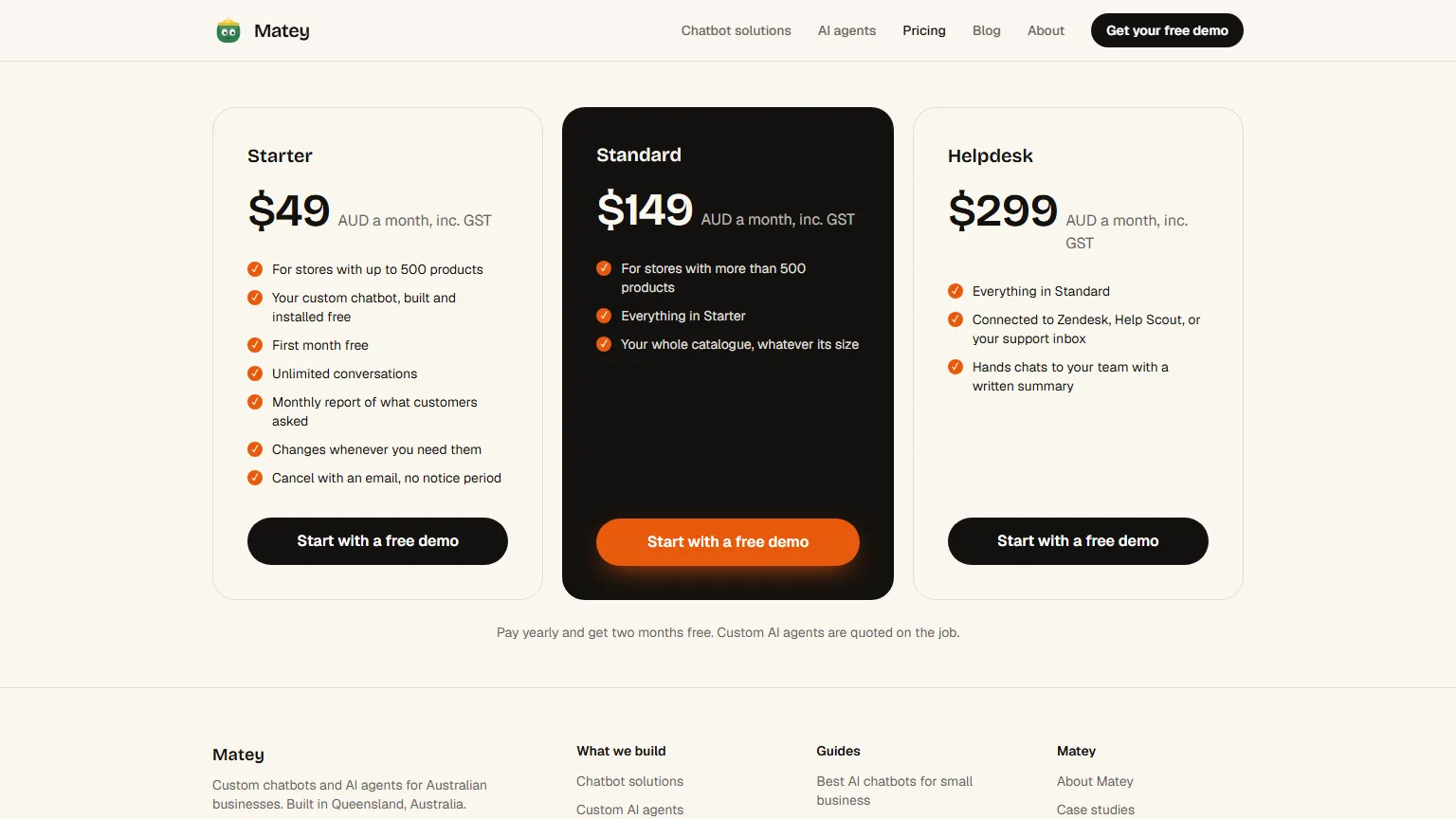
Price: $49 AUD a month for stores with up to 500 products, $149 a month for bigger catalogues, and $299 a month with Zendesk, Help Scout, or your support inbox connected. Every plan has unlimited conversations. The build and install are free, the first month is free, and you cancel with an email. It's all on Matey's pricing page.
2. Offshore virtual assistant
An offshore virtual assistant is a remote worker, usually in the Philippines, who answers your store's emails and chats during set hours. Australian agencies find them, handle the pay, and charge you an hourly rate.
Best for: order admin that needs a person: processing returns, chasing couriers, fixing addresses, and picking up the chats an AI agent hands over.
Drawbacks: a virtual assistant answers at human speed, one ticket at a time, and only on their shift, so the 9pm question waits for the morning. They start out knowing nothing about your products, so expect weeks of training before they answer the way you would, and the training starts again if they leave. Until then, product questions get a template or a "let me check and get back to you".
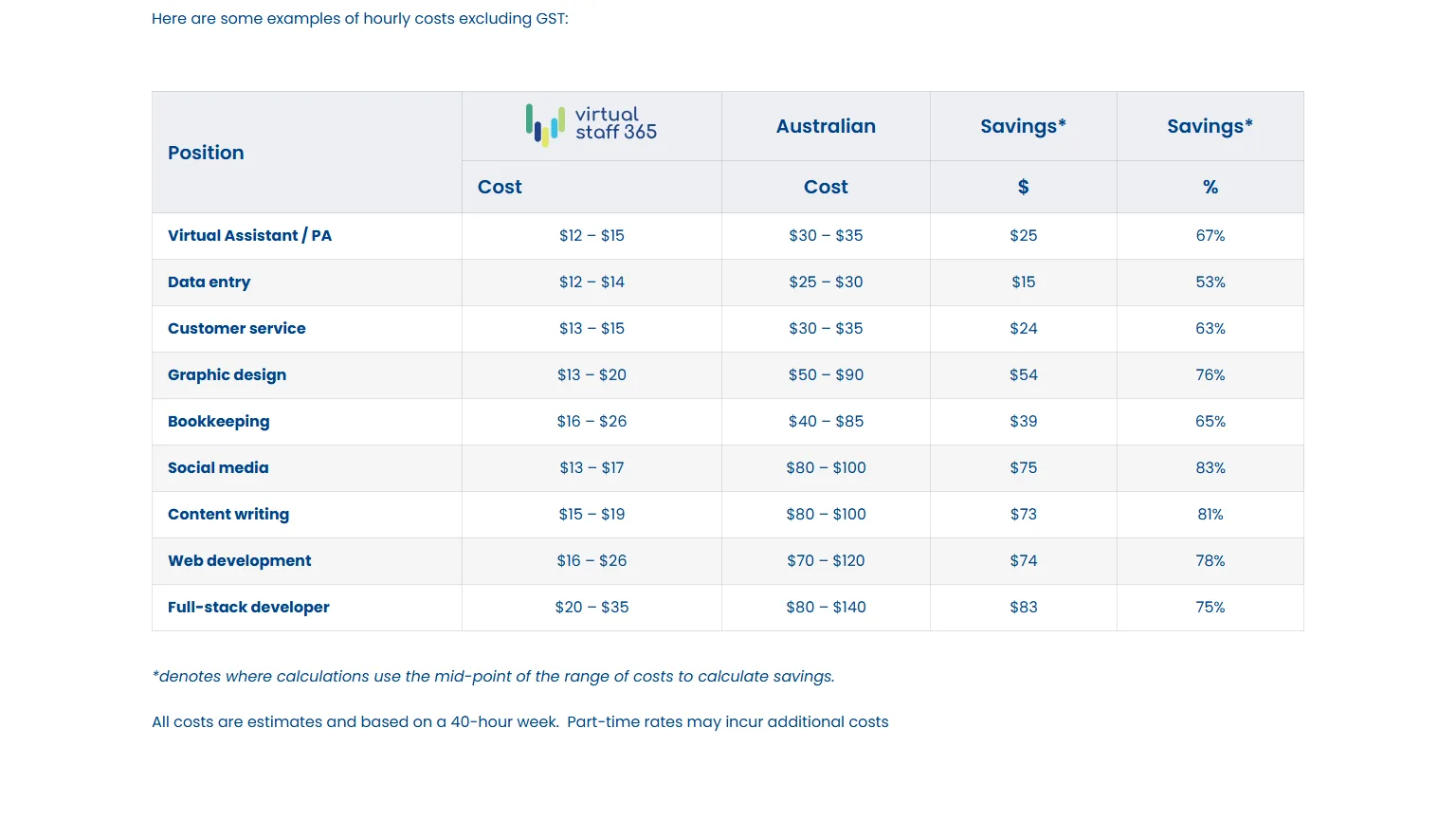
Price: Virtual Coworker lists customer support staff from $8 AUD an hour, for 20 to 40 hours a week. VirtualStaff365 lists customer service at $13 to $15 an hour before GST, for a 40-hour week. One full-time assistant comes to about $1,400 to $2,600 a month.
3. Offshore customer service company
An offshore customer service company, often called a BPO, runs a team of agents overseas who answer your phone, email, and chat in your store's name. You pay per agent hour, per ticket, or per minute.
Best for: big stores with steady, high volumes and someone to manage the account.
Drawbacks: agents often work across several brands at once, so they know your store from a script and a briefing. Every new product, sale, or policy change has to be briefed in before they can answer it, and cover outside their set hours costs extra. Your customers' details also leave Australia, which brings Australia's privacy rules into it.
Price: call centres in the Philippines and India charge under US$25 an hour on average, according to Clutch's call centre pricing guide. That's under about $36 an hour, per agent.
4. Australian call centre
An Australian call centre answers your customers from here, with local voices and local hours. Most handle phone calls first, and some take emails and chats too.
Best for: stores whose customers like to ring, and who want an Australian voice when they do.
Drawbacks: it's the dearest way to outsource support, and after-hours cover costs more again. The agents still only know your store from the briefing you give them, so a detailed product question comes back to you.
Price: Australian call centres charge US$25 to US$49 an hour on average, about $36 to $71 an hour per agent, according to Clutch's 2026 call centre pricing guide.
5. Your own support person
Hiring your own support person isn't outsourcing, but it's the price every outsourcing quote gets compared with. You get someone who knows your products, works in your systems, and cares how the store goes.
Best for: stores with enough emails, calls, and returns for a full-time role, and the time to manage someone.
Drawbacks: one person covers one shift. Holidays, sick days, and the run into Christmas still need cover, and nobody's on at 9pm unless you pay for it.
Price: at least $26.44 an hour, the National Minimum Wage from 1 July 2026 (Fair Work Ombudsman), and the award that covers the role may pay more. Full time at 38 hours a week, that's about $52,250 a year before super.
How much does it cost to outsource ecommerce customer service in Australia?
Outsourcing ecommerce customer service in Australia costs about $8 to $15 an hour for an offshore virtual assistant and about $36 to $71 an hour for an Australian call centre. AI agents charge by the month or by the conversation instead.
Here's one month of support from each option, with one full-time person or one AI agent doing the work.
| Option | One month of support (AUD) | How we worked it out |
|---|---|---|
| Matey | $49 to $299 | Flat by plan, unlimited conversations, any hour |
| Offshore virtual assistant | About $1,400 to $2,600, before GST | $8 to $15 an hour, 40 hours a week |
| Your own support person | About $4,350, plus super | $1,004.90 a week at the National Minimum Wage |
| Offshore customer service company | Up to about $6,300 | Under US$25 an hour, 40 hours a week |
| Australian call centre | About $6,300 to $12,300 | US$25 to US$49 an hour, 40 hours a week |
Every option but Matey covers about 40 hours. A week has 168, so answering around the clock with people takes about four full-time staff.
What are the disadvantages of outsourcing ecommerce customer support?
The disadvantages of outsourcing ecommerce customer support are slow answers, staff who don't know your products, extra hand-offs, and your customers' details leaving the business.
- It's slow. People answer one ticket at a time, during their shift. In Matey's own chat data, 58.6% of shopper chats come in before 9am, after 5pm, or on weekends, so a team on business hours answers most of them the next working day.
- They don't know your products. "Does the linen midi run small?" needs someone who knows the range. An outsourced agent opens the size chart, guesses, or asks you.
- It adds hand-offs. Anything off the script comes back to you, and the customer waits twice.
- It's one more person to manage. Someone has to brief every sale and policy change, check the answers, and train the replacement when an agent leaves.
- Your customers' details leave the business. Names, addresses, and order histories go to another company, often in another country.
That's why we don't love outsourcing for shoppers' questions. People are still the right call for the work that needs hands and judgement: refunds on real orders, couriers, faulty items, and phone calls.
Can AI replace outsourced ecommerce customer support?
AI can replace most outsourced ecommerce customer support, because most of it is the same questions about sizes, prices, delivery, and returns. Refunds on real orders, faulty items, lost parcels, and phone calls still need a person.
In Matey's chats with shoppers, 24.4% ask about size and fit, 14.2% about prices, sales, and codes, and 13% about returns and exchanges. An AI agent answers those in seconds from your catalogue and policies, at any hour. A good one hands the rest over with the customer's details and the whole conversation, so your person starts with everything they need.
Here's a matey on a made-up outdoor store, putting a first camping kit together for a family:
Can an AI chatbot connect to Zendesk?
Yes. An AI chatbot can connect to Zendesk, so it answers customers on your website and in your support queue, and hands anything that needs a person to your team as a Zendesk ticket.
Matey's Helpdesk plan does this for a flat $299 AUD a month, and your team keeps working in Zendesk the way it does now.
- On your website, the matey answers shoppers while they browse: sizes, stock, delivery, and returns.
- In Zendesk, the repeat questions that come in by email get answered from the same products and policies.
- When a person is needed, the matey hands it to your team as a Zendesk ticket with a written summary and the customer's details.
- Help Scout or a plain support inbox works the same way.
It's the setup for stores that already have a support team. The matey takes the repeat questions off the queue, and your team only sees the tickets that need them.
Zendesk's own AI agents are priced by automated resolution, and Zendesk's plans start at US$19 per agent a month, paid yearly, according to Zendesk's pricing page. Zendesk bills in US dollars, euros, pounds, or Brazilian reais, not Australian dollars. Matey's Helpdesk plan is one flat price in Australian dollars, however many questions it answers.
Is it legal to outsource customer service overseas from Australia?
Yes, it's legal to outsource customer service overseas from Australia, but your business stays responsible for your customers' details and what they're told.
If the Privacy Act covers your business, Australian Privacy Principle 8 says you must take reasonable steps so an overseas provider handles your customers' personal information properly, and you're accountable for what it does with it (OAIC).
The OAIC says most small businesses, those turning over $3 million a year or less, aren't covered by the Privacy Act, though some are, like health service providers. Either way, whatever your outsourced team promises a customer, your store has promised. Give any outsourced team, human or AI, your real policies in writing, and check what it tells your customers.
How to choose an ecommerce support outsourcing provider
To choose an ecommerce support outsourcing provider, check what your customers ask and when, then test each provider on a question only your staff would know and price your busiest month in AUD.
We call it the Matey outsourcing test: seven checks before you hand your customers to anyone, AI or human.
- Count last month's questions by type. Sizes, prices, delivery, returns, and orders. The repeat ones are what an AI agent takes off you.
- Check when they came in. If half arrive after 5pm or on weekends, a 9-to-5 team misses half.
- Ask a question only your staff would know. "Does the linen dress run small?" See who gets it right, and how long it takes.
- Price your busiest month in AUD. Black Friday and the run into Christmas, not an average week.
- Ask who answers at 9pm on a Sunday. And what that costs.
- Ask where your customers' details go. Which company, which country, and who can see them.
- Ask how refunds and faults reach you. With the customer's details and the whole conversation, or as a one-line note.
The setup that works for most online stores is both: a matey for the questions, and a person for the parcels. Want to see what a matey would say to your customers? Try a matey on the homepage, or send us your website and we'll build a free demo from your own products and policies.
FAQs
How do you outsource ecommerce customer support in Australia?
To outsource ecommerce customer support in Australia, pick who will answer your customers: an AI agent, an offshore virtual assistant, or a call centre in Australia or overseas. Then give them your products and policies, and set how refunds and faults come back to you.
How much does it cost to outsource ecommerce customer service in Australia?
Outsourcing ecommerce customer service in Australia costs about $8 to $15 an hour for an offshore virtual assistant and about $36 to $71 an hour for an Australian call centre. Full time, that's about $1,400 to $2,600 a month offshore and $6,300 to $12,300 a month in Australia.
Is outsourcing ecommerce customer service to the Philippines worth it?
Outsourcing ecommerce customer service to the Philippines is worth it for order admin that needs a person during set hours, like processing returns and chasing couriers. Australian agencies list Philippines-based customer support staff at about $8 to $15 an hour. For answering shoppers' questions, an AI agent is faster and cheaper, because it answers in seconds at any hour.
Is it legal to outsource customer service overseas from Australia?
Yes, it's legal to outsource customer service overseas from Australia, but your business stays responsible for your customers' details and what they're told. If the Privacy Act covers your business, Australian Privacy Principle 8 says you must take reasonable steps so the overseas provider handles your customers' personal information properly, and you're accountable for what it does with it.
Can an AI chatbot connect to Zendesk?
Yes. An AI chatbot can connect to Zendesk, so it answers customers on your website and in your support queue, and hands anything that needs a person to your team as a Zendesk ticket with a written summary.
Can AI replace outsourced ecommerce customer service?
AI can replace most outsourced ecommerce customer service, because most of it is the same questions about sizes, prices, delivery, and returns. Refunds on real orders, faulty items, lost parcels, and phone calls still need a person.